

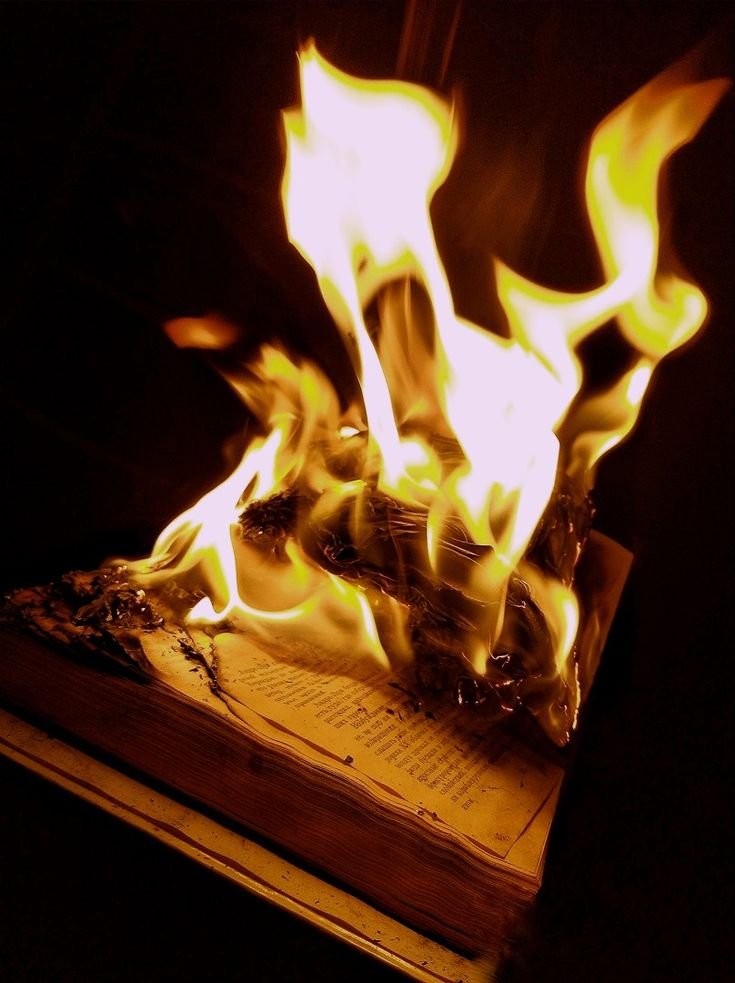
Most book lovers would be absolutely horrified at the words “book burning”—or maybe there’s a book that you hate so much it almost makes you understand the symbolic power of watching a book go up in flames. Book burnings have existed for a very long time but the reasons have been varied. This is a brief history of some of the most interesting cases of book burnings across the globe brought to you by The Bombay Circle Press.
In 213 BCE, Qin Shi Huang in China ordered the burning of books (and allegedly the burying of hundreds of scholars), likely to keep schools of thought under government control as he targeted poetry, philosophy and history manuscripts. Throughout history there have been many instances of book burnings for the suppression of certain philosophies and histories.
Some Ancient Roman rulers allegedly burned predictions made by oracles and details about the popular celebration, Bacchanalia, to prevent the spread of certain customs. In 367 CE, the bishop Athansius demanded that Egyptian monks destroyed writings other than the ones he considered canonical. Uthman ibn ‘Affan who was overseeing compilation of verses in the Quran ordered that the remaining verses should be burned in 650 CE. In the 1560s, the Spanish burned Aztec and Mayan texts.
Many of these early burnings led to the permanent loss of texts in various fields. As manuscripts were written by hand and copied in small numbers, burning was an effective way to wipe out some knowledge in fields including philosophy, science, history and more.
Later, as the printing press was invented and replicated, there was far more information being shared in larger numbers. After this significant invention, burnings continued to be about suppressing ideas but also became more symbolic acts as well. In the 18th century, French philosopher Voltaire’s work was burned by officials in both France and Prussia. Famously, the Nazis burned supposedly ‘un-German’ texts publicly before the war in the 1930s.
Many book burnings have been the result of conquest and war. This has often been carried out through the burning of entire libraries. Often, it is intentional—during World War 2, Nazi armies burned many libraries, particularly in Poland during urban warfare. Sometimes it is an unintentional part of more general destruction. Famously, Julius Caesar ordered that some ships be set on fires to block enemy fleets which led to tens of thousands of works in the Library of Alexandria being burned.
Many of these famous book burnings occurred because someone in power tried to suppress the beliefs or ideas of others. They have resulted in the permanent loss of knowledge that may have otherwise been influential or beneficial. However, this is not the only reason for books being intentionally burned.
Interestingly, some writers have wished for their own works to be burnt and destroyed. Charles Dickens, the author of classics like Oliver Twist burned what some estimate to be thousands of his letters and personal papers. C.S. Lewis, best known as the author of The Chronicles of Narnia, instructed his step-son to burn all his unfinished manuscripts (though some of them were saved by Walter Hooper anyways).
Like Walter Hooper, others have also done their best to prevent book burnings or save books from being suppressed by them. In 1934, Alfred Kantorowicz founded the German Library of Burned Books in Paris which housed copies of books that were burned and suppressed by the Nazis. It was reported to have been popular with German scholars in exile.
Today, people and organisations continue to try preventing books and manuscripts being wiped out. Digital repositories and databases are the most obvious example of this. A famous example of prevention systems specifically for fires is Beinecke Rare Book and Manuscript Library at Yale University. In the event of a fire, a combination of gases will be released to suppress combustion in the book stacks.
While book burning may not be enough to entirely suppress information today, their symbolic power continues to be used in the fight against censorship. In 2022, an “unburnable” edition of Margaret Atwood’s The Handmaid’s Tale was used to raise awareness and funds to counter censorship in the US.
For more such informative reads about the book world, keep a lookout at our bulletin.