

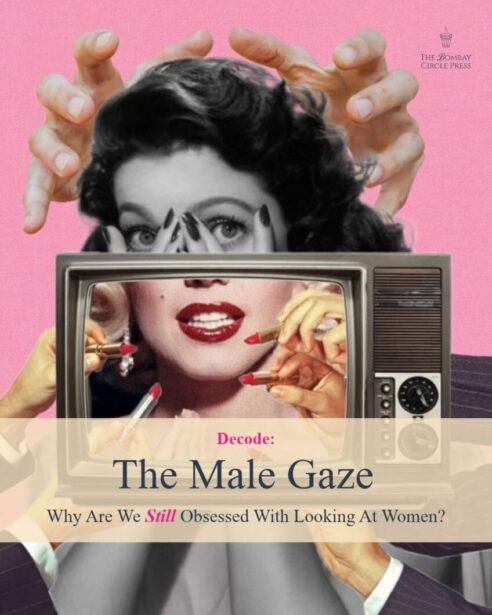
The male gaze does not need permission, and it certainly does not need a camera. Sometimes, all it needs is a sentence.
Sydney Sweeney’s partnership with sports-prediction market and trading app Novig attempts to dismiss critique with a faux-innocent claim that it’s “just sports.” The Ad follows this visual language: sports, spectacle, eroticism, and the male gaze. Critiquing her choices naturally raises questions about female autonomy and body policing. However, we cannot ignore the obvious here.
Throughout history, women have been sexualized across literature, art, fashion, and sports. Female athletes already fight a relentless battle to be seen for their talent rather than their appearance. This Ad exploits female insecurity while packaging it for the male gaze. As a Novig stakeholder, Sweeney knew precisely what kind of backlash she was opening the floodgates to.
By using sports equipment to cover herself, the Ad deliberately drew attention to Sweeney’s body, reflecting the British feminist film theorist, Laura Mulvey’s, The Male Gaze.
“In their traditional exhibitionist role women are simultaneously looked at and displayed, with their appearance coded for strong visual and erotic impact so that they can be said to connote to-be-looked-at-ness.” ― Laura Mulvey, ‘Visual And Other Pleasures’
In response to Sweeney’s advertisement, British Sprinter, 24-year-old, Amy Hunt warned that this portrayal risks becoming a “barrier” to young girls wanting to take part in sport. After finishing fourth in the 200 metres final at the Ultimate Athletics Championship in Budapest (September 2026), she directed her gaze towards the camera and said: “Sydney Sweeney, this is what women in sport look like.”
When the Gaze Finds Its Way Onto the Page…
Take American author Jeffrey Eugenides’ The Marriage Plot (2011), for instance, in which he writes: “Her breasts, of which she was normally proud, had withdrawn into themselves, as if depressed.” There is something almost comical about this sentence, as though the breasts, too, have their own emotional subplot, retreating into a private gloom in response to the character’s inner turmoil. What might have been an ordinary description of bodily self-consciousness becomes an oddly anthropomorphic moment, blurring the line between physical sensation and psychological distress.
A similar tendency appears in Haruki Murakami’s fiction, where women’s bodies often arrive on the page before their interior lives do. In 1Q84, Fuka-Eri is introduced through a distinctly male gaze, with her seventeen-year-old body, particularly her breasts, receiving a disproportionate amount of attention: “Her breasts were perfect hemispheres. Her nipples were not overly large, and they were soft, still quietly groping for the maturity that was to come. Her breasts themselves were large, however, and fully ripe…” You get the gist. Where Eugenides gives the breasts an emotional life of their own, Murakami seems content to let them stand in for a life yet to be fully disclosed. In both cases, the female body becomes a site of narrative fascination, occasionally edging into the absurd, while the question of whose desire governs the description and whose interiority gets left waiting lurks beneath the prose.
A Long Running Pattern…
From his book 2 States to a very public spat with Urfi Javed, Indian author Chetan Bhagat has repeatedly found himself at the centre of conversations about how women are written and talked about.
“Why should any guy want to be only friends with a girl? It’s like agreeing to be near a chocolate cake and never eat it. It’s like sitting in a racing car but not driving it.” argued Indian author Chetan Bhagat in his novel.
Years later, at a literature festival, Bhagat called out Indian influencer, Urfi Javed calling her a “distraction”, saying that the youth sees her photos while they are in bed instead of focusing on their goals. Urfi hit back, questioning why her name had been brought into a literary discussion to begin with.
Urfi in reply to Chetan’s accusations wrote, “Stop promoting rape culture you sickos out there! Blaming a woman’s clothes for the behaviour of men is so 80’s mr@chetanbhagat.”
A woman doesn’t have to be explicitly sexualised for the gaze to be there. Sometimes it is tucked neatly between adjectives, disguised as description, passed off as atmosphere. The question isn’t whether male writers are allowed to describe women. Of course they are. It is why we seem to have carried that gaze straight off the page and into real life.
Final Verdict:
Is Sydney Sweeney an autonomous individual with the right to present herself however she chooses? Absolutely. Yet, does this hypersexualized portrayal create unrealistic expectations for women? Unquestionably.
The problem, then, is not a woman’s choice to embrace her sexuality, but a culture that turns that choice into a template against which all women are measured. What begins as individual expression becomes yet another impossible standard, dressed up as empowerment but enforced through the familiar machinery of scrutiny and comparison.
And that is the ridiculous contract women are still expected to sign: Be beautiful, but don’t look like you’re trying too hard. Be sexy, but don’t be sexualised. Age, but don’t look older. Have children, but don’t let your body show that you did.
So, where does description end and objectification begin? We want to hear your take.