


Imagine being in a rural town in Ireland in the 1960s, stuck in an ever consuming sapphic obsession and an intoxicating thrill of a forbidden romance, Chloe Michelle Howarth brings this world to life.
Born in July 1996 and raised in the West Cork countryside, Chloe Michelle Howarth is one of the most quietly compelling voices to emerge from contemporary Irish fiction. The sweeping rural landscapes of her childhood and the intimate rhythms of country life have left a deep imprint on her imagination. After studying English, Media and Cultural Studies at IADT in Dún Laoghaire, Dublin, Howarth settled in the capital, where she continues to write fiction that is unmistakably Irish in its bones but universal in its emotional reach.
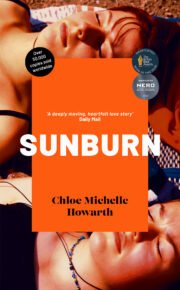 Howarth’s debut novel Sunburn drew immediate attention for the confidence with which she handled ambiguity. From the very beginning, she made a deliberate choice to resist the pull of a tidy resolution. “I knew that I wanted to avoid a happily ever after,” she has said, explaining that a neat conclusion would have felt ‘false’ or ‘cheap’ given how much care she had taken to build characters that felt genuinely human. The decision was not a stylistic flourish, but a belief that real life rarely offers clean endings, and that fiction which pretends otherwise risks a kind of dishonesty.
What Howarth offers in Sunburn instead is something more demanding and more rewarding: possibility. Her characters are always in motion, always becoming, and the novel ends not with a closed door but with several doors left ajar. As Howarth puts it, “My favorite novels are those that leave you thinking. That get your imagination working, and have you considering the characters and their lives long after you’ve closed the book.” This approach places her in a tradition of novelists who trust their readers. It is fiction that works on you after you have closed it, the characters continuing to live in the imagination.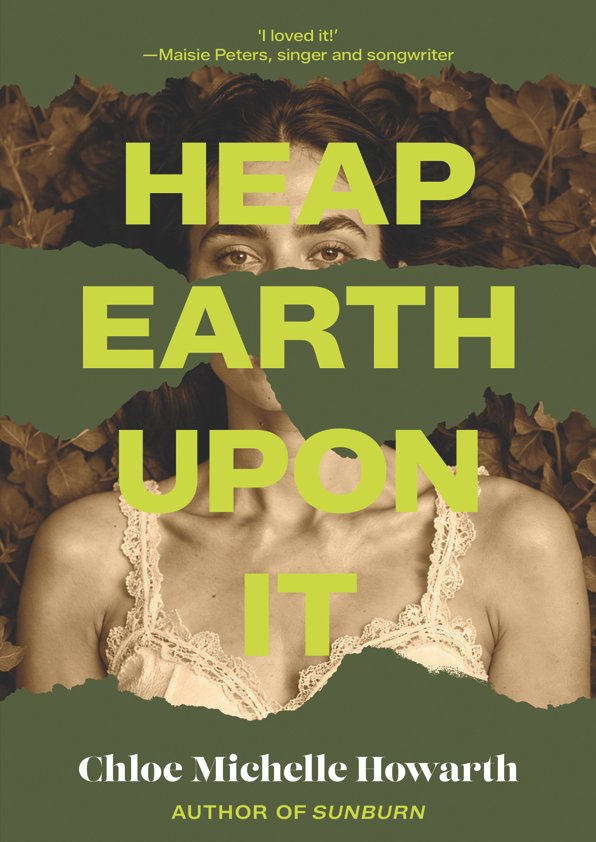
Her second novel, Heap Earth Upon It, marks an assured step into historical fiction. Set in 1960s rural Ireland, it follows the orphaned O’Leary siblings: Tom, Jack, Anna, and Peggy, as they arrive in the village of Ballycrea carrying the weight of a troubled past and a desperate hope for reinvention. Regarded with suspicion by most locals, they find unexpected warmth in their neighbours Bill and Betty Nevan, whose offer of work and companionship feels like salvation. But within that new friendship, one of the O’Learys develops an attachment that slowly becomes something volatile and all-consuming. As Howarth frames it, it is difficult to bury secrets, but almost impossible to bury feelings.
At the heart of the novel is a young woman quietly discovering that she is queer, a realisation that carries enormous weight in a society where, as Howarth notes, homosexuality would not be decriminalised in Ireland until 1993. Her choice of the 1960s is deliberate and thematically rich: she wanted to examine how laws and social attitudes can fall out of step, sometimes with devastating consequences for those caught between the two. The decade also allowed her to strip away modern technology and return to the texture of letters. Perfumed paper, the idiosyncrasies of someone’s handwriting and the charged intimacy of knowing that the person you love has touched the same page. In Howarth’s hands, the love letter is a symbol of courage as much as desire.
“I wanted to explore the ways in which laws and social attitudes can be misaligned, sometimes for the worst. Another reason I chose the 1990s was that I didn’t want the teenage characters to have access to mobile phones,” says Howarth.
Across both novels, Howarth’s style is defined by a quiet precision, an ability to load small moments with large feeling. She writes with patience, allowing her characters to unfold rather than explaining them. Her prose trusts the reader to sit with uncertainty, to find meaning in what is left unsaid as much as what is spoken. Place is never merely a backdrop, the textures of a specific time and landscape, all press themselves into the emotional life of her characters.
Chloe Michelle Howarth is still early in her career, but the seriousness and originality of her vision are already clear. She is a writer who believes in the power of fiction to linger. She strives to keep asking questions long after the story has ended.
“I wanted to explore the ways in which laws and social attitudes can be misaligned, sometimes for the worst. Another reason I chose the 1990s was that I didn’t want the teenage characters to have access to mobile phones.”
— Written by Nurita Datwani